


Stranger Things: Retro Trope Revivals and the end of Reboot Fatigue?
Updated: Feb 6
Neon lights, hair metal, grainy VHS tapes, and scrunchies all are what come to mind when a lot of people think about the 80s. People who grew up during that time might not romanticize it as much, film geeks view the era with reverence, and the Duffer brothers are no exception. The Netflix original Stranger Things had what some may consider a slow burn when it was released in July of 2016, but six short years later and the show may be one of the only things keeping the streaming service afloat in the midst of price raising and cracking down on account sharing. While the show focused on a cast of children, the adults of the series were seasoned actors many older audience members were familiar with. Winona Ryder (whose breakout was almost completely horror-based) and Sean Astin (of Goonies and Lord of The Rings fame), are just two familiar faces in the series who many viewers may associate with the era. This combination of old and new, mixed with a hint of nostalgia made the show accessible to many audiences with many points of view. In a world that cashes in on nostalgia as quickly as possible, could Stranger Things have created lightning in a bottle with a brand new IP that makes viewers feel like they’ve traveled back in time?

With a decade’s experience in the film and tv industry, a focus on horror movies, and an affinity for classics such as Alien or Close Encounters, a sci-fi/horror/drama was not out of the realm of comfort for the Duffer brothers. The Duffers openly share their 80’s obsession and cite references and inspiration used for the creation of Stranger Things regularly. Many might say that this romanticization of past films could potentially cloud the lens through which the show is watched- putting certain elements on a pedestal. However, it is worth considering that the familiar storytelling, references, and tropes, as well as stylistic choices in filming or shots, utilized give Stranger Things an authentic retro feeling with just enough of a budget and modern technology to make it feel like a new story that audiences haven’t seen elements of before.

What was viewed as a risk upon release, is that the show follows a group of Dungeons and Dragons-loving middle schoolers. While this worked for "The Goonies", in the 2010s, it was hard to ensure the talent of a child cast, and it was even harder not to be compared to The Goonies. The group finds themselves navigating their way through finding a girl with telekinetic powers, and a link to a horrifying alternate dimension-like world known as the “Upside Down”. In true heroes vs villains fashion, monsters come from the upside-down version of Hawkins, Illinois and it is up to the kids and their new friend (Eleven) to defeat them, and save the day. Upon first glance, these elements are all notes viewers are familiar with. The inaugural season elaborates on Eleven’s powers and origin, and the seasons to come follow the kids as the stakes get more serious. All of this happens while they have to endure school, crushes, bullies, and generally trying to enjoy growing up. Now on its fourth season, with one to go, one question that has been left unaddressed time and time again is, “what is the upside down?”. Viewers learn where the monsters (named by the cast after D & D monsters) are coming from, and how to defeat them, but not why they’re coming to Hawkins. They see Nancy and Jonathan end up dating, but not what happens to Steve Harringtons’ love life. They know El has siblings, but not where they all went or how they all got to Hawkins Lab. The more answers viewers get each season, the more questions arise, and the Duffer brothers leave just enough to the imagination to keep fans theorizing while they await the next episode, be it through context clues in the show, or by learning about the D & D monsters and drawing comparisons. It is this mix of familiarity and uncertainty that makes the show as binge-worthy as it is spine-chilling.
When creating Stranger Things, the Duffer brothers cite inspiration from numerous classic IPs and well-known creators. In interviews with the Hollywood Reporter as well as IGN the pair mention Aliens, ET, Stephen King, Wes Craven, and Spielberg. Many of these are household names even today- but especially in the 80s, so it is no secret where the inspiration came from. One thing that was deemed important to the Duffers was being able to push the boundaries of TV, blending the lines between television in film. This feeling of nostalgia was at the forefront of the show's conception, even using a novel from the time to inspire the iconic Stranger Things font.

When it came to monsters and eerie reveals or shots, the pair referenced things like Alien and Close Encounters of The Third Kind. Eagle-eyed fans would be quick to point out these references early in the show, all the way to the Freddy Krueger similarities in 2022’s season four. For some, these tropes or shots may feel too similar to the franchises they are paying homage to, but for the Duffers combining the feelings of wonder, skepticism, fear, and curiosity from films like Jaws, E.T. and It was paramount. Different characters were included in the show to elicit different reactions. Joyce and Hopper viewed the world with a lens of disbelief and skepticism. Will was scared, Mike was brave, and Dustin and Lucas were frightened, yet determined to save their friend and eventually the town. What was important to the Duffers was to showcase “ordinary people” interacting with the extraordinary.

Through these different lenses, and paying artistic homage to the stories that preceded the franchise, the Duffers were able to side-step campy pitfalls and avoid predictability almost altogether. True fans of the craft, the Duffers were able to have their cake and eat it too, without needing to outright copy or imitate any one single genre or franchise. This love for boundary-pushing media is what set Stranger Things up to be the most successful show of its kind.
A grievance many viewers have with the show, is often that it is too “stereotypical”. This was not a complaint until a bit later in the series when a cheerleader who would (literally) die to be skinny, a stoner, and an outcasted metalhead all were recurring characters. By this point, however, the show had made a point to turn stereotypes on their heads. Steve Harrington is often cited as having one of the best character arcs of the last decade. Steve (portrayed by Joe Keery), goes from being viewed as the douchey bully, to the heroic babysitter in just a few seasons. So what made this work? What makes some character tropes in writing okay, and tolerable to audiences? Perspective.
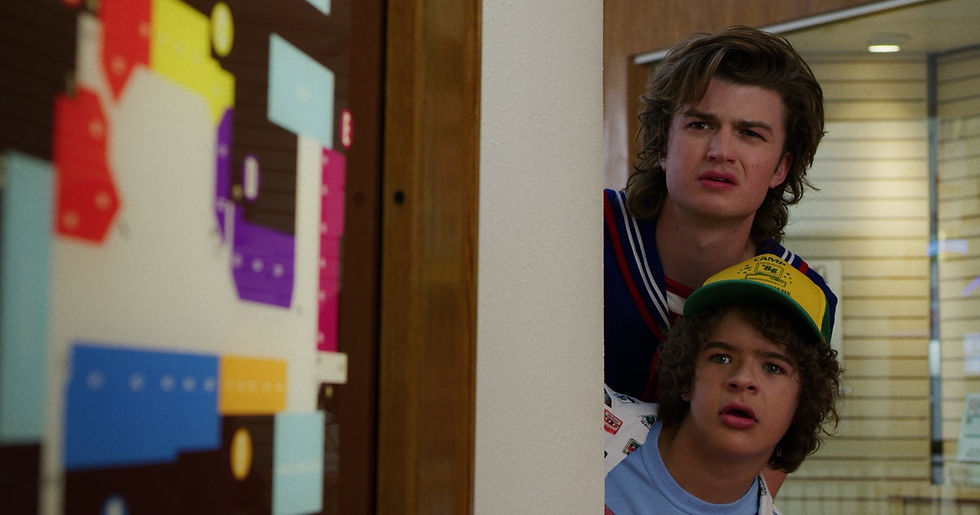
In true Scooby-Doo fashion, the show often follows the cast at different locations with different tasks. This allows for more intimate and personable interactions between characters. In season one, many fans saw Steve only through the eyes of children, and his girlfriend (Mike’s sister) Nancy Wheeler (portrayed by Natalia Dyer). This is important because it gives us only a fraction of the picture. By the time fans see Harrington in season 4, he is a positive male role model for Dustin, has had two jobs because he can’t get into college and his dad denied financial assistance almost immediately after graduation, he has a rivalry with bully Billy Hargrove and is a supportive LGBT+ ally. When first introduced in Stranger Things many characters may fall into popular 80’s tropes, but the mold and boundaries are pushed with any character development or relationships between two or more characters. Storytelling in this way is harder in a two-hour film like the ones the Duffers watched growing up, but across multiple episodes and seasons, it is easy to see characters change to eventually become fan favorites.
In the end, the Duffer brothers show viewers that it is possible to feel a sense of nostalgic whimsy without needing a reboot of a franchise. If creatives love and respect a genre enough, it is easy to pull inspiration and ask “What would we like to watch?” and create something entirely new. Risk-taking, subverting expectations, and adding a level of mystery all make for good storytelling, but adding aesthetics, nostalgia and even varying degrees of playfulness make that story feel natural and makes the world feel authentic. Fans can ignore a stereotype they’ve seen before because it is with a child, they might not know any better, or because “of course” a mother would do something seemingly unheard of to get back her lost son. The relatability allows for audiences to sustain disbelief and be whisked away to 1980s Hawkins, and the Upside Down instead of saying “oh this is just like that one movie! I WISH this was an updated version of that” when watching it. While it is unlikely to see something with throwback energy be done so successfully when considering all of these elements (and more) it is no surprise that the Netflix original has had such success in its penultimate season, certainly stranger things have happened.
Watch season 4 of Stranger Things on Netflix now.


Comments