


The Progress Paradox and Perseverance of Failures: An Analysis of Fallout
Fallout was never just a cautionary tale about capitalism; it is a warning about you.

What does the Fallout franchise think will happen to humanity when the apocalypse doesn’t really end the world, and instead, things just…continue?
At its heart, the franchise is all about what people choose to create after survival is no longer a major problem. It’s not about surviving the apocalypse, corrupt governments, or the woes of capitalism, but about finding purpose after that. How to keep going. The nuclear apocalypse wasn’t just an experiment or a means to an end for the resource wars. It unleashed what lies at the core of most people's hearts. Fallout shows fans what it means to progress and what drives us to keep going.
As wasteland explorers, players have experienced the vastness of the wasteland, from the NCR’s politics across the Mojave to the shattered ruins of the Capital wasteland, to the quiet and slightly less scenic mountains of Appalachia, and even…baseball stadiums in Boston.
In essence, Fallout epitomizes the creation of new identities and societal constructs amidst the remnants of a bygone era, with the wasteland as a canvas for these narratives. The concept of wastelands in video games, as explored by Souvik Mukherjee, highlights their dual role as both 'non-places' and 'any-space-whatevers,' meaning they are settings that can lack identity while still being ripe with potential for meaning-making (Mukherjee, 2019). Players navigate this paradox by encountering relics of an old world, such as pre-war advertisements promoting atomic optimism, which blend irony and real-world commentary with nostalgia. This interaction reflects the inherent absurdities of past societal ideals while simultaneously planting the seeds for new forms of community and culture forged from the ruins. Therefore, the wasteland is not just a backdrop but a dynamic entity that challenges individuals to redefine existence beyond survival.
Every corner of Fallout’s wasteland is a reminder of the world that once was. Fallout takes place in an America where nuclear energy is the main fuel, allowing the nation to boom. Sugary sodas in glass bottles represent joy and well-being. Vault-Tec promises bright colors, everyday comforts, and the promise that everyone who buys in will be safe and ready for the nuclear future that the company guarantees.

But underneath the shiny turquoise enamel and catchy tunes of the 2077 United States, the end of the world was already happening. Not because of madness or at the hands of ghoulish monsters, but because of a resource war no one wanted to stop as long as the money kept coming in.
Two hundred years later, it isn’t the materials of the old world that persevered, but the way that world worked. The bombs leveled entire cities, corporations collapsed, and governmental leadership vanished. The most impactful aftermath of the bombs is that the logic that caused them continues to be the most powerful thing that survived.
The villains of Fallout used to feel obvious. Over time, the writing grew more nuanced, and the dialogue it created seemed much more targeted. However, the real conflict was never just a corporation, faction, or a single bad decision. It’s humanity’s need to leave a mark. The idea that to be amazing, you have to crush those beneath you and be better than your neighbor. Most importantly, the real driving force of the series is the fear that the apocalypse is inevitable, and when it comes, nothing will really change.
FALLOUT AS THE POST-POST APOCALYPSE
What sets Fallout apart from series like The Walking Dead, Snowpiercer, or The Last of Us isn’t just how the world ended, but where society and viewers find themselves afterward.
Unlike other franchises that focus on the survival and near immediate aftermath of the end of the world, the wasteland’s inhabitants aren’t just “survivors.” They’re… residents. The Vault Dweller, the Chosen One, the Courier, and even Lucy all show that centuries after the bombs fell, life continues. The first time players step into the shoes of someone in the wasteland is still almost 200 years after the apocalypse. The only time the player truly experiences being a “survivor” is nearly 20 real-world years after the franchise began, and even that character was frozen in time and long out-lived the bombs. Because of this, it makes it clear the story of Fallout is in the post-post-apocalypse.
History offers examples of just how fast society would rebuild within that time frame. From Hiroshima to post-WWII Poland and the fall of the USSR. But in Fallout, this reconstruction comes with stagnation: the world is rebuilt on the bones of the same systems that caused its collapse. After 200 years some skeletons remain in the bathroom stalls and some massive failures repeat themselves.

Unlike the previous series mentioned, Wastelanders in more populated areas aren’t exactly starving or without hope. They farm, build settlements, lead others, or find purpose in belonging to something bigger than themselves. Fallout’s Wasteland shows what happens once the dust settles and people emerge from their bunkers. New ideologies stem from the ones of the past. Tech falls into the wrong hands,like the Institute or Brotherhood of Steel, and all over the place good intentions are executed by bad men, and man-made tragedies like the Forced Evolutionary Virus ripple forward. The Enclave’s attempt to rebuild the United States is the clearest example. Their plan was described as noble in concept, but is disastrous in execution.
The horror of Fallout isn’t the bombs or the mutated monsters. The horror is that the wasteland isn’t dead, it's just the aftermath of a world that had already decided what mattered most.
200 years after the bombs fall, people already know how to survive. After the end of the world, new questions emerge, and the population shifts its focus on how to prosper and how to safeguard scarce resources yet again. Because 200-year-old survivors, or scholars of the old world, are few and far between, there's no shared experience, no way to directly ask what can be done differently. In mirroring current real-world events, in the Wasteland, no one learns from past mistakes. And in a world where archaic systems persist and old ideologies linger, inhabitants don’t just survive; they define how life goes on.
SCARCITY CREATES IDEOLOGY
Scarcity shapes more than survival; it shapes belief. In the Wasteland, resources are rarely abundant. Even centuries after the bombs fell, the nation isn't booming has only adapted to scarcity. The residents of the Wasteland are descendants of survivors, and they inherit a world where choices are constrained, and the structures built to endure scarcity define how people think, act, and organize. For some, just the lack of socializing - that sense of community- or sense of self can mean completely losing yourself ( like with ghoulification).

The definition of scarcity post-post nuclear apocalypse moves beyond food, but includes safety, trust, and also a sense of purpose for the individual. Even in rebuilt settlements, stagnation persists. People farm, trade, and lead, but all do so within the same systems that failed before the apocalypse. Without good leaders, any system crumbles. Technology falls into the wrong hands. Good actors perform with ill intent. For example, The Brotherhood wants to “protect the wasteland” but at the cost of killing those who - in a cruel twist - are victims themselves to the unforgiving nature of the environment. The Enclave seeks to restore the United States, but the return is a recycled system that enables a war-hungry nation. Some folks just want to “help who needs helping, and hurt who needs hurting,” but even the best examples of this approach (like the beloved Mayor of Goodneighbor) show cracks in the foundation. From the large armies of multi-chapter factions, to vaults tucked away and following the status quo, people will follow who they must, and do what it takes if it means comfort and safety for them and theirs.
These answers all demonstrate how Fallout’s factions are seldom good or evil. The mechanical change of the Karma system in later games only emphasized this subtly.
In a way, factions are much less about morality and more about a reaction to similar feelings of “this can’t happen again.” Innovation and creativity are a privilege, and there’s little space for imagination when life and death are on the line. When ideas are funneled into limited solutions or when resources limit both action and thought, the result is always conflict. Conflict leads to conflicting ideologies, which lead to factions, and the deals and betrayals that shape the Wasteland.
FACTION BREAKDOWN and What Survival Means to Them
The world of Fallout shows humanity’s responses when lack of stability is the biggest obstacle. Lack of stability causes some to hoard, like the Cabots clutching youth as if they were post-apocalyptic vampires. Others seek to have control entirely, which could be organized like Caesar’s Legion, or could present like the opportunistic raiders and Gunners who prey on settlements without the organization or vision to thrive. Some may try to isolate and take only what they need, while others will find ways to help one another as a means to true progress. One thing rings true at the end of the world: when no one has control, anyone can try to seize it.

When the series began, the factions felt more satirical…more removed from reality. But as time progresses, they begin to feel more like art imitating life. To some, the fall of the New California Republic seems like something unavoidable. It's the result of the pursuit of progress and overexpanding too fast in a lawless land, even Hank Mclean addresses this issue (despite the role he had in it).
In the beginning, the Enclave was the obvious antagonist. But with the introduction of more nuanced takes, like Synth rights, automated men or larger questions like the misuse of tech in the old world, the question of who's right and who's wrong evolved. This moral gray area was heavily built upon in 2010’s Fallout: New Vegas and creators behind the series always had plans to build upon it more. In an interview about his works with the AVCLUB, co-creator/loremaster Chris Avellone said, “I think, actually, any morality system that rewards only the extremes is a flawed system. Players don't approach life that way, they don't approach games that way, and they shouldn't be trained to approach games that way.” This is the mindset that made early Fallout entries, and New Vegas (and to a lesser degree Fallout 3 and 4) so much more impactful.
In the world of Fallout, militarization is a common response. Though organized militia can carry nobler intentions, as seen with the Brotherhood of Steel marshalling power to protect the Wasteland rather than exploit it, to the outsider looking in, they are just Technofascists taking what isn't theirs and eviscerating anyone different from them. In the same militant vein, Caesar’s Legion had control of much of the Mojave, but their leader only followed the conqueror mentality as a direct response to the idea of recreating America’s past mistakes.

The Enclave and even the Institute share this mindset in their own way. All chasing what once was and sometimes going as far as kidnapping in the name of progress. What makes these groups scarier than the average super mutant horde or automaton-controlling gunner group is their ability to organize. Every faction thinks they're in the right, doing what they can to progress. But to many, it's just evil by any other name.
All of these factions have answers to the scarcity issue, but none avoid the price of answering it, creating their own pros and cons. All give a sense of worth to the people involved. And they're all built directly off of an ideology that came before it, but helping a farmer find their daughter is far less exciting than the power fantasy that comes with wiping out hordes of sick, freaky ghouls…right?
The Enclave - Control the Past to Own the Future
It's impossible to talk about military factions in Fallout, without addressing the Enclave. This shadow government of the pre-war United States has been established as a main antagonist since the first game. How the Enclave has survived two hundred years has been peppered throughout the series since it began.

The problem with the Enclave is that it wants to restore pre-war America, not reinvent it- except by way of purification. Pre-war America had control of most of the continent, including the annexation of Canada, a concept that's introduced in the first game, but the brutal reality isn't fully realized until season 2 of the Fallout series on Amazon Prime. Pre-War America also controlled most of the world’s oil, and the Enclave wanted to retain this power. While wastelanders are squabbling over water chips and mutation, those in the Enclave don't see themselves as the villain because the Enclave sees itself as the last adult in the room.

Months before the bombs dropped, the Enclave was setting its plan in motion. The current US president had been serving from an oil rig for months before that fateful October day. More than that, they had been creating a list of people who would serve to jumpstart the Enclave (and thus the new American government) in the event of a nuclear apocalypse. These actions are recorded throughout history in terminal entries and holotapes and it shows that the Enclave's goal has been to curate humanity, only picking and choosing the upper echelon to survive the end of the world, force-feed the Forced Evolutionary Virus (FEV) to others, and rebuild after that. Unlike the other factions, the Enclave’s formation wasn't a result of the post-apocalypse, it's pre-war America encased in amber, rejecting any impurities that come with the future.
NCR - Rebuilding the Old World
The New California Republic was founded in 2189 and is built on a simple belief: that the world can be saved by recreating what existed before it ended. Laws, borders, elections, currency, not just survival, but civilization. In a wasteland shaped by scarcity, the NCR responds by expanding, securing land, water, and trade routes in the hope that growth will bring stability. Although perhaps foreshadowing the fractured NCR fans see in 2296, faction leaders like Caesar see the cracks in the foundation. According to Caesar in his New Vegas dialogue, “The NCR has all of the problems of the ancient Roman Republic - extreme bureaucracy, corruption, extensive senatorial infighting.” While this references ancient Rome, the United States has also had such comparisons (both in real life and in the universe), so it may not be that far off.
But expansion demands constant conflict. Wars pile up. Resources are stretch thin. What begins as optimism becomes exhaustion. The NCR doesn’t dwindle because its ideals are cruel; it falters because rebuilding the old world requires endless compromise, enforcement, and sacrifice. Both battles against the Ceasar’s Legion at the Hoover Dam were successes for the NCR and the only ones that the Legion definitively lost, but what was lost in resources and manpower had ripples later on.

While the NCR fights visible battles, the greater threat operates quietly. Vault-Tec and its investors don't conquer; they wait. Figures like Hank MacLean hint at a deeper hand; one less interested in rebuilding society than controlling what survives. In trying to save the past, the New California Republic never sees the future shaping itself around them. Shady Sands was the NCR’s capital, and its destruction was detrimental, turning a promising, budding nation into what seemed like a few ill-informed members sprinkled throughout the Mojave.
Brotherhood of Steel - Knowledge as Scarce Resource
The Brotherhood of Steel’s ideology means hoarding knowledge and tech as its main resource. The Brotherhood has chapters throughout the wastes, making its presence known all over. With the vertibirds and power armor commanding respect from denizens, the Brotherhood hoards old-world technology like a religion. The core belief of the faction comes down to “if people have power, they will destroy themselves again, therefore the Brothers must save them”. To the Brotherhood of Steel, survival means restriction of what is available, not progressing towards something new. This mindset is even showcased in the mixed reviewed Fallout 4. The Brotherhood doesn’t stand in awe over the technological advancements the Institute has; it wants to destroy them. And destruction of the Institute won’t happen with new tactics or tech, but by recreating Liberty Prime, a pre-war military experimental robot that was conceived for the Liberation of Anchorage, Alaska, from Chinese occupation.

The Brotherhood’s obsession with safety isn’t unfounded; it is a direct reaction to the notion of “they already failed once, we will not.” And while their stance and how they deal with ghouls and mutants is…unsavoury, it isn’t without reason. This trauma and fear is felt by many of the Brothers who respond with violence. Some hate mutants for hate's sake, but others like Paladin Danse witnessed horrors at the hands of those affected by the FEV, and want to shield others from that fate.
The Brotherhood uses titles like Paladins and Knights, but when it comes to a code of ethics, they are severely lacking- a point that some fans didn’t see clearly until Amazon Prime’s Fallout series. The Brotherhood is depicted as many other military men tend to be: masculine, strong, and disciplined, but also gross and power-hungry. In season one,. Thaddeus is a good example of everything the Brotherhood represents; he withstands being bullied and then bullies the next guy beneath him, and when he moves up, the cycle continues. It isn’t until he’s turned into something else that his opinion of the Brotherhood changes.

The Brotherhood does take care of its tech and treats power-suits as special as they should be treated for huge machines of war. But, when all is said and done, they stand for the idea of stasis. They hate mutants and ghouls because it’s unfamiliar, the FEV is a variable unknown, and radiation is unsafe, but almost every Brother is sure to have been irradiated because of the time spent on the surface. For some serving the Brotherhood, it’s just an excuse to fight and use big guns- and for many players siding with them, there is no noble cause, just the firepower the faction offers. There’s a guise of progress, but the Brotherhood is what happens when man self-preserves because of trauma; the Brotherhood, for all its guns and ships, represents an old-world stuck on its mistakes. A lack of adaptation, borderline fascism, and hanging onto the past with the notion of “if we are in control, the powers that be won’t make the same mistakes”.
Vault-Tec - The Experiment Never Ends
Vault-Tec is Fallout. The entire Wasteland stands in the shadows of Vault-Tec. A sign of capitalism surviving even after the nuclear war. From the beginning, gamers are vault dwellers, and learn about the never-ending experiments the company forced upon unknowing subjects. Recently, it’s been confirmed that even the failed water-chip players learn about in Fallout one had a 30% fail rate. Meaning Vault-execs could pick and choose which vaults would have clean water indefinitely, and which vaults would lose access to man's most valuable resource.
Vault-Tec treats humans as datapoints, and it’s hard to fit it into one clear ideology other than “the shareholders must be pleased” or some other pro-capitalism slop. Because even under the guise of science, Vault-Tec sold out. It sold its vaults to other companies like RobCo, possibly even the Enclave, and test subjects had to BUY their spots in these cruel experiments. To Vault-Tec, survival means indefinite testing, not living.

Vault-Tec lacked a reason to ever stop optimizing its business model. Much like tech companies today (knowingly creating dangerous AI models that are harming not just artists and people, but the very planet we live on), Vault-Tec only cares about the profits. There never was a plan for life after the apocalypse; even the Enclave’s elite had a safe and cozy “control vault.” The only true plan was an endless postponement of consequences.
Before diving into some of the bigger concepts I want to focus on, I do want to address simpler ideologies within the franchise. Here's a quick speedrun into factions I didn’t focus on because they’re either less pivotal to the point of my thesis and mostly seem to serve as game-design choices, or, like in the cases with Caesar’s Legion and Mr.House, I simply don’t have the time to touch on the opposing ideologies without a full-on philosophy lesson. Which, trust me, is incoming, but we can save the politics of New Vegas for another day,
So, speed round:
Caesar’s Legion follows stability through order, but the cost is erasing humanity and any sense of individuality. The Gunners and Raiders of the franchise focus on short-term survival. They may have manpower and sometimes even resources like shelters, but there’s no future when trust or sustainability isn’t a focus. Mr.House has a vision and efficiency, all proven to actually work! But when one man decides everything, it’s just another dictatorship - and that ideology only serves Robert House himself, but not everyone can keep their consciousness alive for 200 years. The Followers of the Apocalypse also worship knowledge, but they use it as an aid. Their downfall is that they’re simply too idealistic to endure, and men like Caesar saw this flaw.
Every one of these factions solves scarcity differently, but none escape its cost.
The Minutemen - Survival Through Mutual Aid
Finally there are those who embrace mutual aid, the “love thy neighbor” approach, that willingness to help others even when resources are scarce. No one embodies that mindset like the Minutemen.

Regardless of how the settlement and basebuilding missions make you feel, the Minutemen represent the average wastelander, and that's why it's so easy to grow in numbers; that's why rumors of their return are celebrated even in a place like Diamond City. In the world of Fallout, the Minutemen represent hope, sustainability and self-sufficiency. A mission so simple, the vision is lost without clear leadership, which is what happened to the Minutemen of old.
When looking at Preston Garvey and restoring the true mission of the Minutemen, its goal isn't to save the world. The goal is to make it a little less awful. Helping isn't exceptional; it's to be expected. It's repetitive. While connecting settlements and uniting the Commonwealth is a practical path, it's also the least eventful.
The introduction to the Minutemen is unique because it's a result of the linear game design Fallout adopted as an attempt by Bethesda to make the franchise more accessible. Concord is one of the first places that players are directed to go to, and the Minutemen are allies right away. In fact, there's not a lot the player can do to make them an enemy; only one path can make the Minutemen aggressive towards the player.
Gameplay mechanics and writing aside. The initial Minutemen mission is a little bit misleading. The sole survivor dons a suit of power armor and a minigun, and mows down raiders who have the last of the Minutemen holed up in Concord. But after that, when the true mission of the Minutemen is revealed, the story gets a bit repetitive. And it could be argued that that's done on purpose. The monotony of everyday life isn't why most gamers pick up an RPG.
Co-creator Chris Avellone has been noted as suggesting it is on creators to support gamers' innate desire to be selfish and power hungry. Bethesda, in no short part, builds games that allow players to act out these power fantasies, and it seems as though it's almost intentional that the Minutemen missions are boring. Even if the reward for doing them is massive artillery that can drop bombs from across the map. Bethesda issues aside, it could be argued that it's not just for gameplay purposes; the Minutemen missions are boring because making the world better a little bit at a time is boring. If it wasn't, more people would be doing it before the consequences get so dire; both in Fallout, and the real world.

WHY GAMERS HATE THE MINUTEMEN
In what would be labeled as “woke socialist propaganda” in modern America is, in the wasteland, often the most practical path to survival. It replaces a power fantasy with the responsibility of protecting your settlement, establishing sustainable resources, and showing wastelanders that safety is possible. Still, even if it feels like all settlements are saved and supply lines are made… there's always “another settlement needs your help”.
Chris Avellone has talked about adhering to gamers' power fantasies on more than one occasion, and Bethesda team members have lamented about how storylines are often disregarded and skipped over by gamers. The Minutemen introduction is almost the antithesis of both of these concepts. The Minutemen interactions are riddled with a lack of player agency. Aside from killing named faction members, there’s no real way to even truly make the Minutemen hostile until the Nuka-World DLC. In fact, without modding the game or completely ignoring Preston, there’s no alternate way to approach the Minutemen introduction at all. Gamers are sent to Concord EARLY in Fallout 4, and stumble upon Preston Garvey and crew quickly. They don the T-45 power armor, get a minigun, and even fight a Deathclaw after shooting down some raiders.
This mission was important as it sets the tone for Fallout 4 after the prologue, and introduces core mechanics and recurring enemies; it also feeds into gamers' power fantasy and that desire for escapism. While it is early in the game, the power armor and minigun combo makes the raiders a non-threat, and while the deathclaw is always challenging, far less so when the sole survivor is essentially a walking tank. Every beat in this introduction is what gamers want, and the Minutemen make their way to the Sole Survivor’s pre-war home neighborhood of Sanctuary, which is where the highlighted feature for Fallout 4 is introduced- the workshops.
The workshops and settlements were a new inclusion for a Bethesda title- and are partially to blame for why the game's towns are severely lacking compared to other titles. Developers need to push this feature, and it being uniquely tied to the Minutemen is the first nail in the coffin for the faction, but looking at it from an ideological standpoint, it could be argued that that design choice was intentional.

Fixing up settlements and creating trade routes can become a full-time job in-game. Getting armor, weapons, and food for the settlers makes it even more labor-intensive. There’s no special in-game achievement, only more settlements, and a cool weapon if you save enough of those. Many gamers lament on how endless it all seems, there are even mods that just make Preston Garvey more bearable. That constant call-to-action to save settlements feels like work, not the escapism gamers long for. The fact that a settlement could be an oasis, a haven for settlers, and not get any acknowledgement makes it feel less special for players. In real life, the idea of receiving mutual aid makes many feel less special because it’s expected in certain communities.
In a place like the Commonwealth, a person could make a name for themselves in Diamond City but if you’re a settlement with the Minutemen? It’s just another day of farming, scrapping, and another settlement needing your help.
The Minutemen promise stability over progress. Their version of advancement is modest by design: making tomorrow slightly easier than today. This ideology shows in the quick, repeatable, and almost mundane missions, and how easily settlements can be repaired. Life improves, but only just enough to keep going.
That modesty comes at a cost. There’s no ladder to climb, no grand city to build, no promise of greatness. Settlers aren’t heroes or pioneers, and their role isn’t to rise above the Wasteland, but to tend to it and help out their fellow neighbors. With the Minutemen help is expected, not exceptional. And because it’s expected, it’s also endlessly repeatable. The Minutemen missions all mirror a kind of labor most players aren’t looking to escape into but escape from. The work never ends. The gratitude is fleeting. There’s always another settlement that needs help.
The repetition and assured safety is also the greatest strengths for The Minutemen. Though small and scattered compared to that of the NCR, or the Brotherhood, the routes between settlements form a network, shared resources, mutual defense, and even artillery that can reach across the Commonwealth. Protection without conquest. Safety without endless war. The monsters are kept at bay, not by domination, but by cooperation.

Ultimately, it’s the same in-game and in the real world. The Minutemen aren’t disliked because they’re weak. They’re disliked because they challenge the fantasy. They suggest that the Wasteland doesn’t need a savior, just people willing to show up, again and again.
And that’s why the inclusion of the Minutemen feels uncomfortable for gamers. Their ideology doesn’t offer transcendence, dominance, or legacy. It offers maintenance. Care. Responsibility. A future built slowly, without applause. In a genre obsessed with endings, bombs, monsters, and final solutions, the Minutemen ask a far more unsettling question:
If the world ended tomorrow, would we rebuild it together…or would we search for another way to feel important and call that progress?
The End That Never Ends
Fallout is full of endings that don’t really end. The bombs come down, and they end the resource war, the government collapses and the version of society we are familiar with disappears, and yet….time marches on. Everything continues. It’s not just a story about the flaws of capitalism or shadow governments; it’s a story about what happens when the end doesn’t mean anything at all.
Most post-apocalypse stories are about survival, but you enter the Wasteland nearly 200 years after survival is secured, and people are trying to continue upward and onward into whatever the new world may look like.
With this in mind, the concept of Fallout becomes larger than the sum of its parts- the mechanics, factions’ ideologies, and sometimes-profound commentary on the state of the government, capitalism, and the powers that be all mean something more. It’s about mankind’s desire to destroy itself, over and over again, and the impact fans have as willing participants.
It’s easy to look at Fallout and say, “capitalism bad!” “war bad!” But, from the beginning, the franchise has been painting a picture that the concept of progress and mankind's desire to be on top is what planted the seeds for its downfall.

Contemporary philosopher Slavoj Zizek uses Marxist concepts to address the cissue of apitalism as a result of desire theory, and concludes that the concept of capitalism introduces ideologies that will fundamentally divide and ruin society, and even if they know it is happening they will willingly participate anyway. Zizek argues that the brain doesn’t just create desires so one is happy when it reaches the goal, but to be stimulated, to stay interested, and to be focused. (2009) This is the world Fallout was based on. The resource war, mega-corporations and the empire-like status of the 13 American Commonwealths were all attempts to consolidate power, and when one goal was hit, another was made. It’s an apocalypse that was built on keeping the process going, and 200 years later, it continues to trek.
In the Wasteland, factions are constantly at war. If you follow any storyline across any game, you’ll find that none of the factions actually want peace; they want permanence.
The factions endlessly repeat the same patterns. The NCR focuses on rebuilding the old world and the systems that caused it to implode. The Brotherhood hordes old technology, no matter what chapter you find yourself in. The Enclave and Vault-Tec focus on preserving power through control, the same struggle that caused the resource war in the first place. Every possible outcome leads to the same ending.

One of the most controversial Freudian philosophical theories is that of the “death drive”, also referred to as Thanatos. In short, the concept is introduced as a sort of antithesis to the notion that the average mind will seek pleasure at all costs. Freud then goes on to embrace G.T. Fechner’s stability principle, which says the psyche will tend towards unity more than pleasure. Eventually, this leads Freud to conclude that everything we want leads us back to death, and our brains are programmed to be that way. From a Freudian perspective, life just happens in between inanimate states. (1964) Freud accepts that we have desires and seek pleasures, but that is because the psyche seeks to balance out the death drive at the root of it all.
Considering this, and your power-seeking adventures through the Wasteland begin to mirror the world of Fallout- and thus the real world itself. You chase the new armor, get the new perks and guns, avoid wasting your time helping unless it helps you get to those goals, only to become an unconquerable enemy, one who has few weaknesses at the end of the world- but at the cost of those around you. And the world remains compelling even if you know how it ends, because there isn’t a death wish, but compulsion to repeat these desires; even if the repetition destroys an already ruined world. In a sense, this connection makes you no better than those who dropped the bombs. There’s no care for the bigger picture, or helping the little guys like The Minutemen, only what comes next, progressing forward, and marching towards another end. Showing us that the world of Fallout, and our world itself, won’t ever be frozen in time, but forever trapped in a loop. Doomed to meet the end over and over. Every attempt at “progress” preserves what caused the collapse. Rebuilding the past doesn’t create a future.
While Freud’s theories are controversial, the argument for the presence of death and pleasure drives has never been so clear in a game as it is in the world of Fallout. The series showcases the inherent flaw of man, and introduces a paradox of progress. German philosopher Georg Wilhelm Friedrich Hegel (yes, that Hegel mentioned in New Vegas) refers to this kind of paradox as Aufhebung. At its core, Aufhebung is the act of something being broken down while it’s being preserved, transcending the original concept and evolving the base idea (Rotenstreich, 1994). When looking at the current political climate, considering this theory makes the comparison between our world and the Wasteland even more apparent.

Fallout exists in a world where death has already happened, and no one is allowed to move on. The apocalypse became a reset button, and the Wasteland is just an area to maintain the status quo. Scarcity creates ideology. Ideology creates factions. Factions repeat the past. When there’s no progress, purpose becomes fleeting. Groups like the Minutemen show that purpose has to be a conscious choice, one you make over and over again, because it’s never actually going to be the final destination.
Fallout’s world isn’t broken, just like ours; it’s stuck. Corporations are still competing, the experiments never end, and war…war never changes.
Who Really Dropped the Bombs?
After experiencing what the Fallout franchise has to offer, there’s no answer to “which faction is right”, because the real question becomes “why does the world keep ending, even with you in it?”
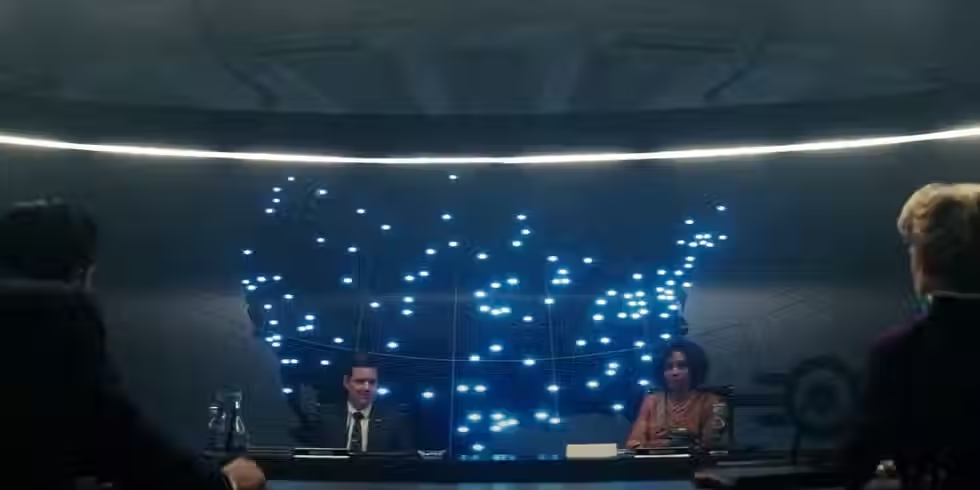
Wastelanders have the same three answers to scarcity, the same answers humans have had since the beginning of time. Control it, hide from it, or share what little is left. Only one force outlasts every faction, squabble, and ideology: the player.
As the main character, you shape the wasteland. You decide who makes it to another day, which systems survive and which ones fail, and regardless of your choices, Fallout quietly rewards you with what everyone so obviously wants: power. More influence, bigger and better guns and armor, and clean endings for whatever path you chose.
Building supply lines is tedious, and helping settlements is optional. Stealing resources, or wiping out a faction is concrete. That feels decisive. Fallout allows you to feel the temptation every faction gives into, the belief that progress means dominance, and that responsibility is something you can ignore with little to no consequence. The game doesn’t force you to repeat history. It just makes it easy.
That’s why the apocalypse never really ends; the bombs didn’t destroy the world. They just reset the board. The radiation will get to you long before you have to suffer from consequences or watch the next loop in time. That’s why, two hundred years later, the Wasteland is still running on the same logic as the world before it. There's no accountability or reflection. Optimization, power, and progress all for no other reason other than familiarity.

The Minutemen are the only faction that refuses to flatter you. There’s no legacy or fulfillment of a savior complex. Only asking you to show up again. And again. And again. They’re boring because being kind is boring, responsibility is never-ending,and maintaining it is thankless. The Wasteland changes people, and it takes a lot to be a good man. So, rejecting the uninteresting in favor of progress is an obvious given.
Fallout is so much more than critiquing capitalism, governments, and individual ideologies. Beneath it all, the series is addressing the power fantasy itself and critiquing the belief that the world can be fixed by one decisive act, one person, or one perfect ending. Because in the Wasteland, every time you choose conquest over care, efficiency over empathy, or spectacle over stability… the world doesn’t collapse again. It simply stays the same.
The question Fallout leaves you with isn’t really about war, capitalism, or even the factions.
It’s this: If you survived the end of the world, would you rebuild it differently? Would you retreat into familiar comforts? Or would you chase power, simply because it’s there?

In its critique of endless materialistic desires and Hegelian dialectics, Fallout suggests that the greatness of mankind doesn’t stem from our ability to progress or stomping down on our opponents just to climb the ladder; greatness is a byproduct of taking responsibility. Not from saving the world once, but from choosing to care for it over and over again.
RESOURCES
--------------
Mukherjee, S. (2019). Videogame Wastelands as (Non-)Places and “Any-Space-Whatevers.” Transcript Verlag EBooks, 167–184. https://doi.org/10.1515/9783839447307-009
AVC at GDC '10: An interview with Alpha Protocol creator Chris Avellone. (2010, March 12). AV Club. https://www.avclub.com/avc-at-gdc-10-an-interview-with-alpha-protocol-creator-1798219328
Bradley Aaron, (2025, December 2). “Players are selfish”: Fallout 2’s Chris Avellone describes his game design philosophy. Ars Technica.
Horti, S. (2026, January 15). Bethesda's former Elder Scrolls loremaster on why he left, Starfield's 'communication breakdowns',… PC Gamer.
Sean Homer. (2013). To Begin at the Beginning Again: Žižek in Yugoslavia. Slavic Review, 72(4), 708–727. https://doi.org/10.5612/slavicreview.72.4.0708
Žižek, S. (2009). First as tragedy, then as farce. Verso.
Kraut, R. (1994). Desire and the Human Good. Proceedings and Addresses of the American Philosophical Association, 68(2), 39–54. https://doi.org/10.2307/3130590
Freud, S., & Schupper, F. X. (1964). On Love and The Death-Drive. American Imago, 21(3/4), 3–10. http://www.jstor.org/stable/26302172
ROTENSTREICH, N., & Pöggeler, O. (1994). SUBLATION AND REFLECTION. Hegel-Studien, 29, 63–77. http://www.jstor.org/stable/26598277
TIME. “Behavior: Freud and Death.” TIME, nextgen, 17 July 1972, time.com/archive/6815588/behavior-freud-and-death/.


Comments