


NOPE and the Curse of The Spectacle (Analysis and Review)
Updated: Feb 6
(there will obviously be heavy spoilers here. The movie released JULY 22, 2022. So if you haven’t seen it yet, get on it! Even if you aren’t a fan of traditional alien films, or horror)

Ellen Ripley, Close Encounters, Men in Black, and even X-Files are all works that come to mind when many people think of media portrayals of aliens. In real life, viewers might think of Area-51 (and naruto running) or the occasional crop circle. What doesn’t come to mind is alien exploitation, allegories for the spectacle of cinema, or Black ranch owners. With Jordan Peele’s latest release NOPE the way audiences see aliens as they know it has been flipped on its head. Like Peele’s previous works, as well as projects he has helped to produce and write, NOPE is as rich in symbolism and cultural commentary as it is in cinematography and talented storytelling. Despite the critical acclaim the film has received, are audiences missing the point entirely, and has Jordan Peele lost his touch as a pioneer of the social horror genre? Or, is NOPE exactly what more casual movie-goers need to see to truly understand the industry, and hold it to a higher standard?
Nope takes place in California and hosts a colorful cast of complex characters. The movie follows its main character Otis Haywood Jr. (played by Daniel Kaluuya) and his sister Emerald Haywood (Keke Palmer) after the untimely demise of their father Otis Haywood Sr. (Keith David). Otis Sr. died in a freak accident of a nickel falling out of the sky and hitting him in the eye, lodging into his brain. When the incident occurred, it was only Otis Sr and Kaluuya’s character (OJ) on their horse ranch north of Hollywood. What follows is Oj’s attempt to save the ranch by selling horses to a neighboring tourist attraction in hopes to buy them back once he can get enough gigs as a horse wrangler in some films. This journey is cut short by the fact that the horses are being fed to what seems to be an extraterrestrial by the owner of the attraction, Ricky Park or, Jupe, from Jupiter’s Legacy (portrayed by Steven Yuen). As the film continues the alien (named Jean Jacket) leaves nothing in its path, as the characters find more ways to avoid and defeat it.
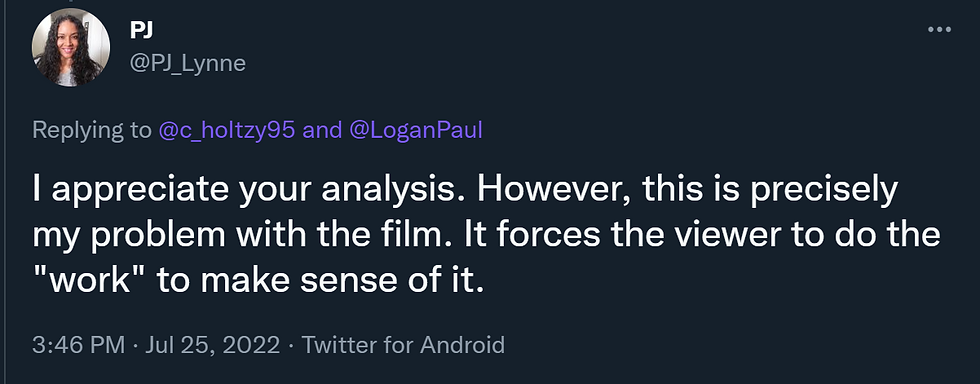
Shortly after its release, one of the great modern philosophers (/j) of the current generation, Logan Paul boasted a 13 part twitter rant about the film. In the Twitter thread, Paul writes, “ It’s not hard to conceptualize something disturbing — it IS hard to sensibly tie it to the plot, which was done remarkably poor here...” followed by a series of questions that were answered in the film, with a few exceptions left up to viewer interpretation. While many mocked Paul for his lack of critical thinking and comprehension skills, some responders agree with the creator in that the film’s shortfall is that it “wants the viewers to do too much work.” The debate between self-proclaimed cinephiles, critics, and viewers who just want good movies to watch are one as old as cinema itself, and this writer would venture to say that’s the entire point of the movie. The nuances involved in many of the tropes and underlying themes are one that would easily be lost upon someone who made their living by creating needless spectacles on the internet, what makes that level of commentary so easy to miss? Are viewers at fault for expecting another instance of social commentary like Peele’s previous work, or is the art of “show don’t tell” dying in cinema?
Overall the film’s story is very straightforward and simple. Ranch in the middle of nowhere, dying industry (as animals being utilized by Hollywood is growing increasingly rare), weird stuff happens, heroes fight to survive and end weird stuff. What makes this film unique is the characters that deliver this story. OJ is a character to who many creatives, especially those in the film industry can relate, he is quiet and reserved but takes his job seriously and respects the history and the animals he works with. Emerald wants more for herself, she wears many hats because of it (and all of them pay off by the end of the film). Emerald was less welcomed into the family business so she sought different ways to stand out, she’s outgoing, a seamstress can do motorcycle work, and is an amazing public speaker. It’s suggested that both adult children are

separate sides of their father and why they need to come together to have the family business be successful. Both characters have a unique and deeply caring relationship, but they showcase it in different ways. Ultimately, Emerald wants to stay safe and enjoy her life while Oj wants to get to the bottom of things so he can fix what's going on
and get back to work.
The side characters of the film all have their own backstories and motives that are deeply impactful for the overarching narrative and commentary of the film. Angel Torres (played by Brandon Perea is the equivalent of a bored Best Buy employee who has his own alien theories, is going through a breakup, and wants nothing more than to help the siblings and see aliens. Torres also seemingly has a crypto mine set up in his bedroom, but that’s not a huge focal point of the character just something more eagle-eyed fans may notice, perhaps it can signify how much Angel truly believes (Aliens, crypto, his ex-girlfriend anything really). Ricky Park is a washed-up child actor with years of trauma trying to reach levels of fame he once had from his time in a popular western, as well as a hit 80s sitcom Gordy’s Home. Ricky experienced firsthand what happens when a wild creature is expected to perform for money and entertainment and eventually turns on the people that capitalize on its exploitation. Two smaller roles in the film are also a director, and what Emerald cites as someone from TMZ on a mirrored helmet riding a motorcycle (a feature that directly calls back to the mirror first showing in a scene with OJ on set in Hollywood). Both of these characters have a tremendous amount of backstory showcased for the brief moments they’re on screen. The director Antlers Holst is played by Micheal Wincott (most known for his role in Westworld). Holst is a renowned director who first turns down the idea to help the team until he knows he can land the money shot - a feat so daring that he gives his life for it. The motorcyclist has the same downfall with the added factor that even when his arms and legs are twisted from crashing- all he cares about is getting his camera back. Overall each nod towards the filmmaking industry gets more literal throughout the film until his climax, but the most telling connections came from the Gordy’s Home flashback, which the film opened with.

In the time since its release, the symbolism behind NOPE has been analyzed and picked apart time and time again. Love it or hate it Peele’s attention to detail is unparalleled, as no line in the film can be regarded as “throwaway lines”, every single beat has a meaning and intention. Jordan Peele is aware of the value of every second of screentime in cinematic storytelling, and he does not do any handholding or verbal exposition the way much of modern storytelling does today. The director posted a cryptic video that was the opening to Gordy’s Home opening week of the film, which was jarring for fans who had already seen the movie. The importance of this sitcom, which features a family who houses a chimpanzee as one of its members, has a slow build-up throughout the film until audiences are granted an entire flashback of the events that occurred. The movie opens with the monkey, covered in blood and having seemingly killed the cast, and the live studio audience- before looking directly at the camera and cutting away (the events eerily mirroring real-life encounters with pet chimpanzees). Later in the film, it was revealed that the monkey was looking at Yuen’s character, a man who immortalized his time on the show with a room full of Gordy’s Home merchandise and propaganda from the show. Gordy made one final gesture of kindness to Park before being shot to death by police, an interaction that leads Park to believe he can tame another wild beast as an adult.
This idea of taming and exploiting wild animals for entertainment is mirrored in both Yuen and Palmer’s characters- as Emerald shares that she was supposed to have her own horse that was impossible to tame. OJ later name’s the antagonist of the film after that same horse, making it all the more meaningful when Emerald later defeats the creature. Jordan Peele has been cited as using animals as recurring themes in his films to draw attention to the disrespect humans have for the creatures. Peele says in an interview with Fox Washington DC., that animals can be “a reminder of how we treat anything that doesn't qualify as human. There's a real-world horror that animals are trapped in. In some ways, they symbolize something very bad about us. That's what my movies are about.” An idea he has touched on once before with the showing of a dead deer in Get Out and with the heavily featured rabbits in Us. OJ is one of the only characters who hold the animals to higher respect and follows the rules of nature, and this eventually leads him to the key element that saves the main cast.
The fact that the film's main antagonist cannot accomplish its goals unless it is looked at, is where the biggest allegory for the film industry comes into play. The alien is named after Haywood's untamable horse, Jean Jacket, and as long as the characters avoid eye contact the creature grows bigger and more angelic in form. The mouth of the creature resembles that of a camera lens, which audiences saw at the start of the film, showing the foreshadowing from the very beginning, for those who could connect the dots. The idea that this alien resembles the “be not afraid” style of angels coincides with the biblical themes throughout Peele’s work. More overtly, the opening text of the film reads "I Will Cast Abominable Filth Upon You, Make You Vile, And Make You A Spectacle. —Nahum 3:6." The original quote from the Hebrew Bible is one that may require some research and context clues if viewers want to decipher a deeper meaning than “spectacle = bad” but it is well worth the rabbit hole. Nineveh, the capital of the Assyrian Empire is a place that is regarded as deeply sinful, and these words reflect judgment upon the city. Another place that suffers because of its reliance on the spectacle is Hollywood. Jean Jacket, serves as a real-life depiction of the judgment being cast, eating whatever looks at the creature and spitting back out the waste and objects they carry. Forward, an independent Jewish nonprofit has noted that one of the recurring numbers in the film is 613, which also holds great importance and symbolism in Jewish scripture. (Read more about that here )
The film is one that builds open itself the more viewers think about it or watch it. The symbolism, foreshadowing, and recurring themes only add to the overall statement of how Hollywood takes advantage of humans and animals alike, as well as ultimately ruins the lives of those who live to chase the spectacle -- the perfect shot. Any film student can tell you the ideas of cinema were built upon the spectacle. As movies grew in popularity, theaters added more to draw crowds, until it was actors and names that bought audiences in.

NOPE follows some unsung heroes of Hollywood (animal wranglers), but this symbolism can go for any members of the crew and filmmaking that go unsung. People do not pay attention to the credits in a film, only what is on screen, they don’t care what goes on behind the scenes, and actors and directors often mistreat crew members because they are expendable. This film coming out at the same time as audiences learn about Marvel’s mistreatment of VFX teams and their poor working conditions can serve to be eye-opening for casual moviegoers who do not pay attention to what makes modern cinema a spectacle. While the characters are imperative to storytelling, and the actors did an amazing job, the use of cinematography and sound design should not go unnoticed in this film.

The sounds of the horses screaming, the use of Corey Hart’s hit “Sunglasses at Night”, and the absence of sound altogether during moments of tension are some of the main ways to bring feelings of stress and fear to audiences. More analytical fans might find deep amusement in the trope of slowing down pop songs to garner a jarring and scary feeling- but it’s even funnier when coupled with the fact that Sunglasses at night is a song about control, being able to look at something that is hard to see, and being unable to escape someone. Peele is a master at combining elements of horror and comedy, with this being no exception. The song plays during what could be regarded as the movie's climax, and at the same time as the characters (and audience) learn that not looking at the creature is what spares someone from being consumed. The movie relies heavily on sounds coming from the environment as cues for what is going on, and the sound of the horse screaming is undoubtedly the most notable, as OJ even references it as a point of concern in the film. This, coupled with the dark scenes that are shown when these more haunting sounds play reminds audiences that this is in fact a horror and not just a social commentary to dissect. Peele makes sure audiences who do not want to look into the deeper meaning of a film have no choice but to pick apart something, but for those who turn a blind eye to the film’s overarching statement- they at least have value in the spectacle - ironically, suffering if they choose to ignore the larger elements at play.

One thing I have gone the last 7 pages of this piece ignoring is the more subtle visual easter eggs. The reference to the tragic shuttle explosions that are shown in the Gordy’s Home fan room and opening, the fact that one of the mauling survivors is at Jupiters Claim, the floating shoe that’s in the background of the flashback, and in Ricky’s secret room. The fact of the matter is, that these things are important to dissecting the film but the film’s value without them is not changed. Every element adds value, but the lack of them does not take anything away. In fact, I have spent more time trying to find the meaning of the shoe than it’s probably worth. I could go into detail about how notable seamstress and long-time friend Briana Bailey mentioned the nickelodeon reference at the start of the movie. The film that went through Otis Sr’s eye was thought to be a nickel, and nickelodeons were one of the earliest ways to watch movies at the time. Nickelodeon is also a film about a group of men who become filmmakers. I could go into detail about all of the set design and wardrobe choices. I could speak on all of those things, but you could just as easily find them in an episode of Heavy Spoilers on Youtube, or a ScreenRant article. But instead, I will address that as much symbolism as the movie holds, it still leaves room for interpretation, which is a lost art in much of today’s modern cinema.

When viewers are focused on the current big superhero film, or whatever blockbuster is out, the thrill of subtly is often lost. Currently, many fans value realism and grit, which is present in all of Peele’s films, but the overall social commentary is what is most important for most of the creator's projects. Each of Peele’s directorial works thus far leaves room for interpretation at the endings (if there is no alternate ending such as with Get Out). When it comes to elements of Nope, there’s always room for meaningful conversation, and there’s always value in rewatching the movie and taking something else out of it the second or third time around. The Gordy’s Home sub-plot showcased Ricky’s desire to tame feral and unfamiliar creatures, and the pride he garnered from doing so. But what was the deal with the shoe? Well. This writer’s interpretation is that audiences are always waiting for the other shoe to drop. Many times this anticipation is responsible for the subsequent reaction or feelings towards a project or event, the build-up and journey are more valuable than what actually happens because what comes, in the end, can always be bad. Audiences see the shoe from Ricky’s point of view- he is the audience. The shoe is floating upright each time viewers see it, leading audiences to wonder what will happen next with it, there is a pit of anxiousness and mystery surrounding it. The same feeling is mirrored when audiences see Gordy glancing at Ricky. That same feeling happens when Ricky sidesteps the idea of letting OJ buy the horses back, and when Oj looks Jean Jacket in the eye, despite knowing it will kill him. In the end, viewers see OJ “out yonder”, and it’s implied that he is just a hallucination of Emerald’s, but it’s not entirely clear when waiting for confirmation the movie ends. There’s no answer to if he lived after the alien died, there's no answer as to what the police involvement will mean for Em, or if she’ll ever end up talking to Oprah. The other shoe never drops.
Jordan Peele’s NOPE is one of his most unique pieces of work thus far. While the director has proven his love for the film and entertainment industry with each of his works, the self-awareness contained within NOPE’s story is one that is unmatched in modern-day cinema. For any true fan of film, NOPE is grounded in reality. It is easy for audiences to suspend disbelief when they know the big “alien” is just of this planet. Like all of Peele’s work, the true horror is people. This time, more specifically Hollywood, and how the industry will chew you up and spit you out, and do anything to garner your attention and energy until you give up, or give your life trying to capture that perfect shot, that perfect moment, that perfect piece. With this unique interpretation of Sci-Fi horror and Alien genres, Peele has solidified his place in the cinematic hall of fame as a director who can truly make something meaningful out of nearly any concept and continues to pioneer the revival of the Social Thriller genre.
While rating this film an undeniable 10/10 and openly admitting I will be seeing it in the theater several times feels like hypocrisy to its message, I think my doing so also proves its point. Everyone chases the alien for some kind of benefit, or just to soothe their curiosities. NOPE is a spectacle in and of itself I for one, cannot look away from.


Comments